
Adjoint Tomography
My primary research interest lies in the field of seismic imaging, which means I use seismic waves and supercomputers to probe the structure of the Earth (think MRI or CT scans). I am primarily interested in imaging the Earth's crust, to understand how structure relates to seismicity and tectonics of a region. Traditionally I employ full waveform techniques like adjoint tomography.
Cryoseismology
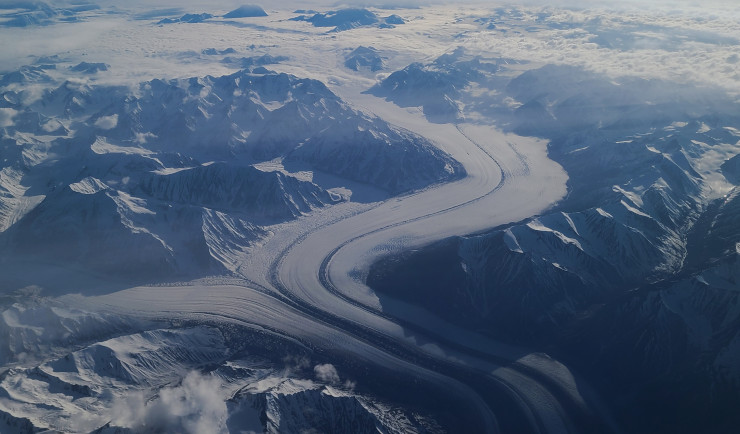
The dynamics of glacier sliding and fracture provides many parallels to earthquakes. Seismological techniques can be applied in glacial settings to tell us more about their structure, movement, and hydrological systems. I am particularly interested in glacier-based seismic field work in Alaska, and how seismology can improve scientific understanding of our icy neighbors, and their futures.
Planetary Seismology
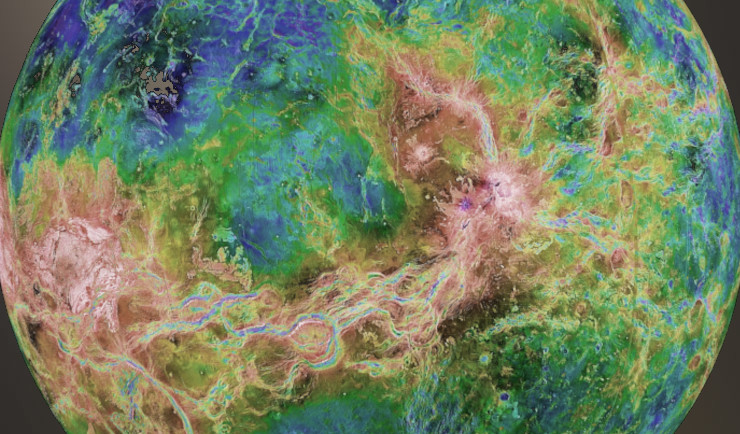
I got into science because I love space. Although I strayed from that original passion, my career in seismology has serendipitously allowed me to wander back. I am part of a NASA project that aims to provide synthetic estimates of seismicity, wind noise, and ground motion for potential future Venus missions, which will help constrain instrument and mission design criteria. (Photo credits: NASA)

Science Outreach
Science is much more meaningful when it can reach beyond its confines to inspire and improve society. I enjoy finding ways to share science in interesting ways, whether through public science talks, art-science collaborations, or unique outreach projects. I am currently working with visual artist Klara Maisch to understand how to build rewarding art-science collaborations. Click the image above for our AGU2025 poster.

Treaty Monitoring
Modern instrumental seismology was partially born out of a need to monitor for, detect, and discriminate nuclear tests from natural seismicity (see: WWSSN). This work continues today under the auspices of the Comprehensive Test Ban Treaty (CTBT). I conduct research with the Wilson Alaska Technical Center focused on improving monitoring capabilities for CTBT efforts.

Open Source Software
To perform my research, I develop, maintain, and rely on open source software. I am a big proponent of openly available data and software to make science more transparent, accessible and reproducible.
